Tuesday, July 17, 2012

When the wrong thing is the right thing


On Sunday at 5am I embarked to complete what I anticipate will be the second leg of my around Long Island paddle. I started in Shinnicock Bay and paddled to Smith Point Park. The trip is about 25 miles. This map is my actual track as recorded with the MapMyRun app for my Droid.
I managed to get an early start and when I reached Ponquogue bridge, I was treated to a magnificent sunrise. There are actually two Ponquoque bridges, the new one and the old one. The picture is of the new bridge. Most of the old bridge was demolished in the 1980s. What is left is a fishing pier to the North and a SCUBA diving preserve to the South. 


If you are a SCUBA diver and you want to dive this preserve, be careful or you will get swept away from the bridge and be taken for quite a ride. The current running through this area at a non slack tide is deadly extreme. You should enter the 1 hour and 21 minutes after high tide for Shinnecock inlet as published in Newsday. Do not stay in the water any more than about 35 minutes. If you feel the tide start to turn, immediately take a southerly heading and stay under water because the current is stronger on the surface. You shouldn't panic because if you keep heading south you will eventually reach the eddy caused by the structure of the bridge and be able to easily swim back to the bridge itself. I have been diving here before and it is a great dive!! 


As for my paddle, at first the water was calm, then the wind picked up and of course, it was dead against me. After about five hours of continual paddling, my right shoulder started to hurt. Usually, I would just ignore a minor annoyance such as this but this pain seemed different. It felt like it was coming from my rotator cuff. As you might imagine, this freaked me out a bit. I honestly have no time for a shoulder tear right now. As I paddled, I explored different stroke technique. None of them seemed to help. Then, finally, I decided to paddle with my hands. I strapped the paddle to the kayak, leaned forward and did sort-of an Australian crawl. It helped! I was able to keep my shoulders low and thus engaging different muscles. I would have just stopped paddling and rested but every time I stopped paddling, the wind would push me back. I had to keep moving or lose ground. I paddled like this for about a mile. Then I tried using my paddle again but instead of a "proper" stroke, I used mainly my arms. This also helped to rest my shoulder. Slowly, I raised my stroke and was able to paddle normally without shoulder pain. When I got finished over 6.5 hours later, I was exhausted. I burned over 3400 Calories! That is like burning a whole pound of fat in ONE exercise session! My main lesson from this experience is the importance of being body aware. When I paddle, or SCUBA or rock climb, etc. I constantly do mental body scans and try to interpret what I am feeling. This helps me to safely push through minor annoying pain, modify my activity so that I can continue or just find a way to stop and rest. 

Saturday, July 7, 2012

What is YOUR most important thing?

This morning I kayaked for 4.5 hours straight. I managed to cover over 19 miles and burn 2808 Calories. Why did I do it? I did it to train for the around Long Island Paddle (duh). It is my plan to do the whole 260 miles in 10 days or less so I need to do at least 26 miles (or more) a day. 19 miles in a day is my upper limit right now. That is roughly the distance from Montauk to Block Island, a route that I have taken many times before as part of Paddle for Humanity ( www.p4h.org )

I kinda like the idea of pushing this particular region of my comfort zone. Today's paddle was hard. The wind and the current were against me much of the time. One thing I observed was when I focused on the miles (I wanted to do 20) I would get discouraged because all these external forces were working against me. When I felt discouraged, my performance suffered. 

Then I realized that if I shifted my focus, I could change everything about the experience. It turns out, when your tired and sore, your attitude can be a source of reserve power. 
What if I focused on the incredible value of the training? After all, the training is more important than today's mileage, right? I once had a mentor that said success comes from knowing the most important thing.

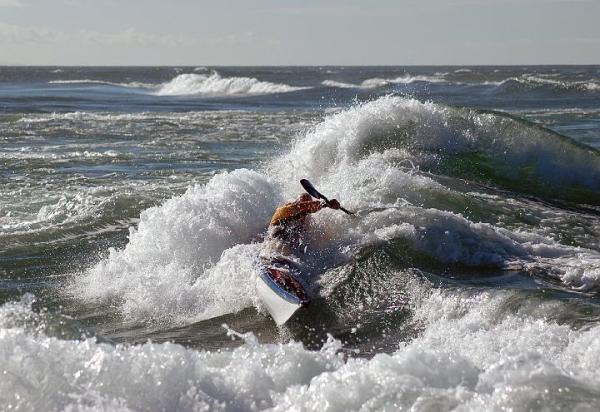
This is not a picture of me.
Although I have been in similar waters.
As I focused on all these forces that were beyond my control, I was limiting what I would actually accomplish today. The most important thing was the training! The mileage was secondary. Besides, the wind, the current, the sun and a ton of boats tossing 3 foot wakes my way will all be here when I do the actual paddle. I needed to train for this. I needed to see the value of the here and now. When I shifted my focus, my attitude changed and it was actually easier to paddle through. This was an AWESOME training day.  
To carry this lesson through to life. I wonder how many other areas of my life would benefit from a shift in focus? There are a lot of times when I am "tired and sore" as I navigate the sometimes rough waters of my life. I often need the reserve power of a renewed perspective. 

I suppose the best way to get this perspective is to stop and ask, "what is the most important thing here?" "What do I REALLY want to accomplish?" 

In my work, I get people to focus on asking themselves the right questions at the right time. The more uncomfortable the question, the better it is for you. 

What questions make you uncomfortable?

When I help people lose weight, I continually ask them to evaluate their focus. Is the number on the scale the most important thing? If you answer yes then you might quit if the scale rebels against you. Also, people who focus on the scale tend to gain the weight back after they lose it. Why? Generally, they regain because they lose focus. They figure they have arrived so there is no reason to worry about it anymore. 
What I have found is that lasting weight loss comes when people focus on the life they gain. They get jazzed about being healthy, climbing mountains or playing with grand kids. The most important thing for them is life, not weight loss. Living a remarkable life is an constantly renewable source of positive motivation. 

Monday, July 2, 2012

Sunrise training in New Jersey

Took an impromptu hop to the Jersey shore last night with my Jeep, my tent and my kayak.


Sunday, June 24, 2012

My Stupid Kayaking Buddy - Kayaking Safety


This week I stopped by to visit with my friends at Sea Tow® International to discuss my plan to paddle around Long Island. I have been friends with the founding family of Sea Tow for years and they have always found a way to support me in my various waterborne adventures. So it was no surprise to me that they were all in for this jaunt. They offered to provide me safety boat support for the open ocean and Gardiner’s bay legs of the trip.
What a lot of people don’t know is that Sea Tow® is truly committed to keeping people safe on the water. They even formed a boating safety foundation to (http://www.boatingsafety.com) promotes safe boating practices and education initiatives that directly reduce accidents, fatalities and property damage related to recreational boating.  The BoatingSafety.com website is designed to be a single source of boating safety information for the recreational boater. With one stop, a boater can get weather and tides data, the latest local notices to mariners and other safety resources that might be needed. If you spend time on the water, you should check it out.
As I was talking boating safety with Joe Frohnhoefer Jr., he mentioned that according to the latest reports, boating accidents involving kayaks and canoes were on the rise. He also mentioned that a large portion of these accidents resulted in fatalities. While that seems grim, the good news is that paddle sports are actually quite safe if you observe some basic safety principles.
1. Stay alert. Always assume that other boaters do not see you. If you see a boat heading directly toward you, make every effort to paddle out of their way. You may think you have the right of way but, that won’t matter if they hit you. The best indication that another boat sees you is when they make a large and obvious course change to avoid you.
2. Stay visible. Wear bright clothing. You might even consider flying a flag or a cheap radar reflector. How visible you need to be will be determined on where you paddle. If you go out in to large bodies of open water you will blend in easily.
3. Stay in Touch. Have a cell phone in a water proof case and / or a VHF marine radio.
4. Make some noise. I have a whistle on my life jacket. This comes in real handy when boats get too close. Remember with the engines humming and the radio blasting, most boaters will not hear you screaming.
5. Stay Afloat. Always, always, always wear a life jacket. I am an expert swimmer. So what. I wear my life jacket because if I end up in the water exhausted or unconscious, my swimming skills don’t mean squat. Wearing a life jacket is not a sign of weakness, it is a sign of intelligence.
6. Stay Protected. Skin cancer is no joke! According to skincancer.org, “a person's risk for melanoma--the most serious form of skin cancer--doubles if he or she has had five or more sunburns.” My father died of melanoma. It was so aggressive, it took him in six weeks. As far as we can figure, the seed of this cancer was planted in the 1950’s when he got sun poisoning in North Africa while serving in the Marines. Wear a hat, protective clothing and sunscreen.
7. Stay Hydrated and Fueled. Even if you are only going to be in your canoe or kayak for a short period of time it is essential to bring a full water bottle with you. It is quite common for paddlers to become dehydrated due to the combined effect that the sun and wind have on the body. Also, you will be expending a lot of energy even if you don’t realize it so be sure to bring a snack so you don’t get light-headed from hunger.
8. Be Prepared. I always carry rope, something to bail out unwanted water, a knife and a basic first aid kit.
Now remember this is just a guide. The equipment you will need will vary by where, when and for how long you paddle. The main thing you need to do is to think before you go. Unfortunately, many of us don’t take advise like this seriously until something bad happens. If we are lucky, we survive the experience and learn valuable lessons. This is exactly what happened to me a few years ago. Below is an adaptation of a story that I wrote following one of those near misses.

Every morning I get up at 5am, suit up, and jump in my kayak. I wear my life jacket, carry a whistle and always bring a cell phone encased in plastic bag. As you might imagine, it is difficult to find paddling partners at 5 in the morning but I know, in the interest of safety, I should not go out alone.
One morning in early May, I recruited my life-long companion "stupidity." Stupidity and I were almost inseparable when I was young and we were especially close when I was in college. But, that's another story. On this particular morning, in May, the wind was blowing about force 5 (19 - 24 knots), the skies were threatening and the water was cold. I thought about staying in that morning but stupidity was excited about the adventure and who was I to disappoint. So I put on my .5mm wetsuit and off we went.
When we got to the beach, we were blown back by the sheer force of the Southeast wind. I looked north into the protected creeks; stupidity looked out into the open bay. I was soon outvoted by stupidity's sense of adventure. Stupidity argued that it would be a valuable experience to battle the heavy weather and I bought it. Dead into the weather we went.
As we headed out, the bow crashed into the waves as we skillfully powered our way to weather. As the sea crashed over the deck and onto the spray skirt - we were impressed with our kayaking skill. We continued on for the next 2 nautical miles without incident.
When we arrived at the cove of Robbin's Island, it was time to turn around. I thought it might be best to head directly to the lee shore and then hug the coast to home. Stupidity thought we should hang a 90 degree turn to port and head to the closer shore of the Nassau Point. Of course, this would put the wind directly at our beam. Why do I listen?
As I turned the boat, my stability worsened (big surprise) and the ride became precarious. I decided to head-up into the wind for a few strokes and then fall off the wind to ride the crests of the waves toward the homeward shore. Stupidity thought that would be a great idea. As I carried myself further and further into the wind, the sea took me. What I mean to say is that the waves flipped me like the coin at the start of a football game.
Now upside down, I discovered that stupidity had thrown our paddle away. After a few attempts at a paddle-less roll, I performed a wet exit (that means I got the heck out of the boat). Did I mention that it was about now that the skies opened up to the worst downpour that I had seen all year? Through the blinding rain I noticed my paddle floating about 30 feet windward of me and the gap was widening. Stupidity told me to swim for it and get the paddle. For the first time all morning, I told stupidity to #*$@%#$! off. I was going to stay with my boat. Since a self rescue with my paddle was out of the question, I was down to plan "B" - Call for help.
I reached for my phone which was sealed into a plastic bag with a simple knot (stupidity's idea) and cleverly tethered to my PFD. The problem, as it turned out, was that the knot in the bag was not exactly water-proof. For those of you that may not have experienced this, cell phones and salt water do not mix. The phone was dead. Time for Plan C.
Luckily, stupidity had a plan C. Plan C: let's try cowboy jumping this puppy from the stern, slip into the cockpit, reseal the skirt and pump out. This plan may actually have worked if it weren't for the 4 foot seas. So much for plan C. Time for plan D.
The problem was that I had no plan D. Tired, cold and paddle-less it was time to formulate a plan D. I had nothing left. I just wanted to be home. I was a mile and a half from the lee shore and all I could think of was to start swimming. I clutched the kayak as tightly as I could, presented as much hull to the wind as was possible and made for shore.
After just 2 hours in the water, I was tossed ashore in heavy surf. I dragged my boat up the beach and pumped it out. I began walking the quiet streets of New Suffolk looking for an early riser to make the "call of humiliation" to my wife. I now tether my paddle to my life jacket, use a dry pouch made for cell phones, choose my days more carefully, give considerable thought to the routes I take and am more selective with my kayak partners.

Sunday, June 10, 2012

Fulfill Your Life with a Series of Remarkable Journeys


10 years ago I liberated myself of over 200 pounds of excess body weight. It was an epic journey that tested my limits. I am grateful to have my new life as a 200 pound man, but I am also grateful for the lessons that I learned as a obese man and as a man losing weight.

Doc Russ in his first kayak after losing 100 pounds
Since that time I have dedicated my life to helping other people liberate themselves from the excess weight that keeps them from living the life they really want. I know losing weight is an epic challenge but I have done it and I have helped other people do it too. In my work, I get to witness ordinary people do extraordinary things. Think about this, if other, ordinary, people can do this, SO CAN YOU.


On Friday September 7th, 2012 I will be embarking on another epic journey that will test my limits. I will kayak around Long Island, NY alone. While I plan to stop each night, I will paddle the entire approx 275 mile circumference of the Island.


Doc Russ with kayak after losing 200 pounds
Why am I doing this? I am doing this to show that, weight loss is not about losing ANYTHING. It is about giving yourself the opportunity to live an AWESOME LIFE. Weight loss is not about the newest diet pill, or plan, miracle berry or super food. It is about actively living a remarkable life. I am doing this to show that there is an entire world beyond the video screen and fast food drive through. I am doing this to show that you, whoever you are, can live a remarkable life too.


I Love My Life! 


Dr.Russ L'HommeDieu, DPT
Nationwide: 888.4DocRuss (888) 436-2787 Manhattan (212) 365-4438   Hamptons (631) 488-0070  North Fork (631) 772-9212


Saturday, June 9, 2012

My Personal Mission Statement


I love the way I feel and I appreciate my body as a vehicle to a remarkable life. 
I am a person that values my contribution to the world.
I am committed to living my life as an example to others. 
I will use the gifts of my life to help others see the best in themselves and become the best they can be. 
I create systems and tools that supported them in creating a most incredible life for themselves. 
I instill upon people the importance in sharing the gifts of their life in a way that lifts and supports others. 

Thursday, June 7, 2012

Action Giving is a source of MoJo (Motivational Joy)


Whether you are losing weight or have reached your goal, it is important to keep your body moving. The good news is that almost any kind of movement will do as long as you do it and keep doing it. In order to be effective, however, staying active needs to be a long-term commitment that does not end when you have lost all the weight you want to lose.

According to the National Weight Loss Registry, engaging in a consistent activity program is a key element in the maintenance of any weight loss success. Did I say long-term commitment? I meant life-long commitment. Yes, that means that movement needs to become part of your life. That may sound like some kind of prison sentence but if you do something you really enjoy doing it’s not that difficult.

If any of you have a bad case of insomnia one morning around 4am and happen to be strolling along a beach on the North Fork of Long Island, you might catch a glimpse of me blissfully gliding along the surface of the bay in a kayak. I enjoy it so much; I can't even call it exercise. Make no mistake, though, I do manage to elevate my heart rate. I actually paddle hard enough to exceed the speed of an average 30 foot sailboat under full sail. I know this because I have confused many a sailor as I quietly whipped by them. The cardiovascular benefits of paddling are undeniable, the scenery is impossible to beat and the core muscle training is awesome. By the end of the summer I cannot even fit into my shirts because my chest has become so developed. The core strength and flexibility the sport provides me improves every aspect of my physical abilities, especially my balance.

When I kayak I have some unbelievable workout partners, ducks, geese, osprey and loons. There is no better way to “work out” then to do something you love to do. My “gym” is a million miles long and a million miles across, and I will never get to see the whole thing; that’s pretty amazing. The peace and euphoria that this routine brings me sets the tone for my entire day and can last for a week.
Yup, I sure do love to kayak. The problem is that even when you love to do something, the motivation to keep going can still evaporate. Next thing you know, a month or a year goes by and you’re no longer doing anything. The secret to holding on to your motivation is to maintain a deep connection to all that is good about what you are doing. Still, holding on can be difficult.

It was a cold, rainy and windy start to the kayaking season and I don't mind telling you that I was losing my kayaking MoJo (Motivational Joy -- not to be confused with the Cuban Spice also known as MoJo.) I remember too many mornings at the beginning of the season where I just stood on the beach, cold and wet, only to turn around and go home. I did nothing to really move my body on those days and I really felt lousy because of it. It was a bad habit in the making.

One of the main lessons that the challenges in my life have taught me is that every human being has the potential to be better. Certainly, losing over 200 pounds was a challenge but keeping it off- is takin’ some work too! Throughout my weight loss journey I began to see this process of success develop. I began to recognize that the path to the life I really wanted could only be walked one step at a time. I learned that all I had to do was to develop one good habit at a time and stick with it. After a while that good habit became easy and it was time to make a better habit. I discovered that all I needed to do in order to stay on this path of improvement was to just keep collecting these small, positive changes. After a while, I developed a system that allowed me to focus on the changes that best suited me.

I call this system Betterness ®. Simply put; Betterness ® is defined as the process of radical life improvement through the accumulation of small but consistently performed positive changes. Although there is way more to the actual system than that, the key here is that you need to keep doing what you are doing. In the case of my daily kayaking “habit” all I had to do was keep on doing it. Unfortunately, sometimes Betterness just that ain’t that easy.
I define “Action Giving” as the act of giving by doing something physical. This kind of charity is not only good for you but it gives you the opportunity to make a real difference in the lives of others. It is an awesome way to stay motivated to keep your body moving. Yes, even I, with my professed love for kayaking can use a motivational boost.

My MoJo was rescued back in 2007 by the Paddle for Humanity. The paddle for humanity is an 18 mile open ocean charity paddle from Montauk, NY to Block Island, RI. It is held every year in early September.  Who would have believed that the same 400 pound man struggling to stay on an exercise bike for 5 minutes would cross almost 20 miles of Open Ocean in a 15 foot kayak? Believe it! I did it for three years and this year I am going out on my own to do a charity kayak of almost 300 miles around Long Island!

How did this give my MoJo back? All I needed to do to get my MoJo going was to think about all the people whose lives might change if I could keep paddling. I knew the only way for me to endure the grueling 18 miles to Block was to get my butt into that boat and paddle - every day. Since getting started is always the hardest part, all I needed was a little shot of MoJo and soon I was blissfully ripping along like always. As I continued to train, I stayed motivated by getting sponsors. I knew that people were depending on ME and I was not going to let them down. I knew that when I finally left the safety of Montauk, I would not be alone. I would have all of the collective energy of my sponsors and their beneficiaries behind me. As I paddled, I couldn’t help thinking about the real people whose lives will be made better by the causes we were supporting. I am truly grateful that I am able to make a difference in the world, contribute to my own wellbeing and do something I love to do in the process. This kind of giving is a great way to stay motivated on the sometimes difficult road of Betterness.

As it turns out, often a little motivation is all we really need. If you don’t think action giving is powerfully motivating, it is only because you have not yet experienced it. Yes, you too can be an “action giver” and don't have to risk shark attacks, muscle cramps, being lost at sea or even getting wet. OK, so I’m being dramatic. When I do these crazy paddles, they are actually extremely well organized and safe there is no chance of being lost at sea, the sharks out there are well fed enough to leave us paddlers alone and my training keeps the muscle cramps away. I am quite sure, however, that staying dry is not an option. So, if getting wet is not your thing, there are many good causes that will get you moving.
Perhaps the American Cancer Society's Relay for Life is the most familiar to you. Did you also know that the Obesity Action Coalition and the American Society for Metabolic and Bariatric Surgery jointly organize the walk from obesity? (http://www.walkfromobesity.com/)The proceeds from this event support obesity research and obesity advocacy. If you are overweight, as I was, and ever felt isolated, alone and misunderstood, this is a great cause for you to support! The march of dimes also comes to mind. These events are held all over the country at various times which gives you plenty of opportunities to get involved. I encourage you to find your own way of Action Giving.

When you do sign up, treat the event as true commitment to yourself as well as the beneficiaries of the event itself. Think of your participation as a reason for you to do better, fell better and BE better. Set your mind to the belief that the more you train, the more you AND the world will benefit. Honestly, you can change the world with just one positive thought provided it is followed by an action. So be active! Don’t just show up on the day of the event and expect to simply stroll around. When you get there, seek to be an example to everyone else. Since you have trained, you will not only feel better, you will look better as well. You will exude an enthusiasm that will be infectious. The way you look feel and act will attract attention. People will want to know about your new Betterness and you will inspire them. Who knows, your Betterness might even cause someone at the event to hop on the road to Betterness with you. If they did, it would certainly make their life better and it could even lead to a longer, more productive life for them. Think about this: If you can make other people better simply by being better yourself, YOUR Betterness is not a gift you give only to yourself; it is your gift to the world.